


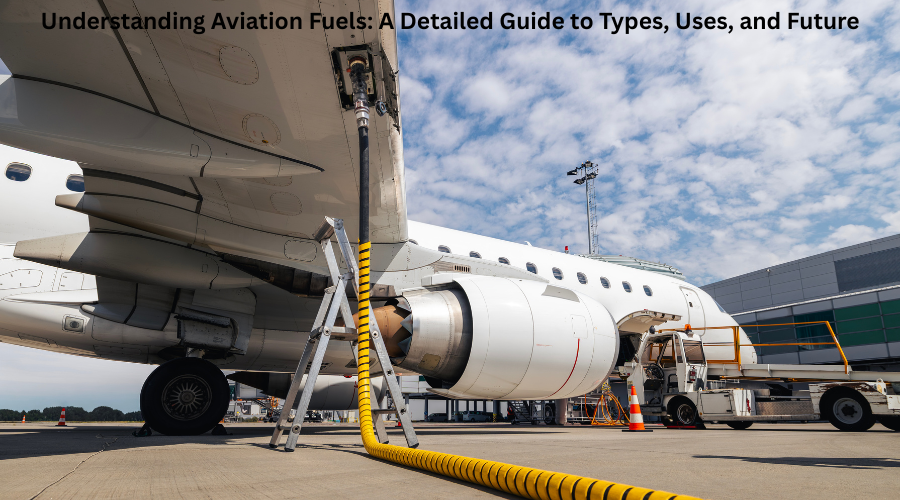
A jet aircraft consumes a specific type of fuel every time it starts up. Not just any fuel. Aviation fuel is specially formulated to function under rigorous conditions. Operating at high altitudes, in cold weather, and under high-power conditions all demand an effective product every time. It can be catastrophic if the wrong fuel is used or if a contaminated batch is used. That is why there is great caution about using aviation fuel in any manufacturing process.
This guide provides an overview of the major fuel categories and applications, as well as the direction in which aviation is moving.
Aviation fuel can be produced from crude oil, but it differs from the fuel used in cars. An aircraft's fuel should operate as low as -50 °C at cruising altitude. It can't freeze, can't foam, and it shouldn't break down under pressure. It must also be stored safely for long periods of time in wing tanks, not absorbing water and never reacting chemically.
In addition to performance, all aviation fuels must meet international specifications. Each batch is tested before any contact with an aircraft. In the UK, organizations such as ASTM International and DEF STAN are responsible for setting standards. All airlines, airports, and fuel suppliers operate within this frame.
These types are the most widely used aviation fuels globally. Generally, fuels are used in commercial jet aircraft or turbine-powered airplanes. The majority of all the flights you have ever flown have used one of these two fuels.
Jet-A is used in the USA, China, and Canada. Jet-A1 is the international standard, and it is used almost everywhere else. These two are similar, except for their freeze point. Jet-A1 is better for long-haul flights over the Arctic and cold areas.
Jet-B is composed of Kerosine and gas. It burns more readily than Jet-A and is more resistant to cold weather. That is, it is also more prone to fire and must be controlled safely. All these are accounted for, and Jet-B is not very common. It is mainly used as a component fuel in the country's special Northern areas, where the use of Jet-A1 can be problematic, including Northern Canada and Alaska.
Avgas is recommended for smaller piston-engine aircraft. Consider light aircraft, small private aircraft, and training aircraft. These engines operate in a manner that is unlike jet turbines.
Tetraethyl lead remains a trace contaminant in Avgas to help prevent engine knocking. This makes it one of the last fuels that are allowed to contain lead. A current research focus in the general aviation industry is finding a replacement for lead.
Not exactly. The kerosene used in jet fuel is a very refined and specifically formulated kerosene. It goes through more extensive refining and treatment than domestic heating kerosene. It also has various additives such as antioxidants, anti-static, and corrosion inhibitors. Domestic kerosene will not meet aviation specifications and is not suitable for use in aviation engines.
Aviation Fuel Storage and handling are serious operations. One of the primary hazards is contamination. Engine issues can be caused by the presence of any amount of water, dirt, or improperly specified fuel types. Care is taken in the management of aviation fuel storage tanks. This water is regularly tested for water content and particulates. There are several times that fuel is filtered before it reaches an aircraft.
Commercial airports have strict procedures for fuelling. Fuel is transported to airports by pipeline or tanker truck. It is kept in on-site tanks dedicated to storing large quantities. Hydrants under the apron or a tanker vehicle provide fuel directly to the aircraft when the aircraft needs fueling. There are checks for quality and quantity at each step.
To prevent fuel confusion, aviation fuels are color-coded. Avgas 100LL is dyed blue. Both Jet-A and Jet-A1 are straw-coloured or clear fuels. This is just one of several visual checks to ensure proper fueling of the right aircraft.
There is a carefully controlled set of additives in aviation fuels. Antioxidants stop the fuel from breaking down while it is stored. Static dissipator additives decrease the accumulation of static current while fueling, eliminating the risk of fire during fueling. Corrosion inhibitors prevent corrosion of components and enhance fuel lubricity, minimizing wear on fuel pumps and valves. A fuel stabilizer is added to the fuel to improve thermal stability and withstand the heat generated by the fuel during use.
Aviation fuel uses a lot of resources. Carbon dioxide, water vapor, and particulate matter are generated from the combustion of jet fuel. Emissions will tend to increase the temperature of the air at the cruising level, not so much in the lower part of the atmosphere. This implies that the aviation sector is among the most difficult to decarbonize.
Industry accounts for approximately 2–3% of the total global CO₂ emissions. The total impact is greater when assessing the full climate impact of high-altitude emissions. It is now one of the aviation sector's largest problems.
The most significant progress in aviation fuel today is known as SAF, otherwise known as sustainable aviation fuel. SAF is made from non-fossil sources. These range from used cooking oil, farm waste, and municipal solid waste to even carbon directly left over in the atmosphere. SAF generates much less greenhouse gas over its lifecycle than traditional jet fuel when burned.
SAF can be mixed with conventional Jet-A or Jet-A1 and be used easily to power current aircraft engines. At this time, blends of up to 50 percent SAF are approved. Improvements are underway with some manufacturers towards achieving 100 percent SAF approval.
SAF's current hurdles are scale and cost. Production is increasing, but supply is still very small. SAF is much more expensive than regular jet fuel. Its application is progressing steadily among airlines when required by regulatory bodies or driven by the company's sustainability goals. Many governments are enacting regulations requiring minimum SAF percentages in aviation fuel, with implementation dates set for specific dates. All three constituents, the EU, the UK, and the US, have targets, all of which are positive for demand over the next few years.
In addition to SAF, hydrogen is becoming another aviation fuel of interest. Hydrogen combusts only to produce water and has a very high energy density by mass. Hydrogen must be liquid-fueled or compressed to high pressure to be transported at very low temperatures. The options both involve major changes in terms of aircraft design and airport infrastructure.
There are already small-scale flights with electric aircraft. For shorter distances and lighter passenger loads, battery-powered planes are viable. However, battery energy density is far short of what is needed for long-haul commercial aircraft applications. There's improvement, but it's still not a reality for the large commercial planes.
Aviation fuel is no ordinary commodity. It's a well-designed, rigorously controlled, and essential component of motion. Today, most aircraft continue to use Jet-A1 and Avgas. However, the drive for emission limits is forcing rapid changes in the industry, the likes of which have never been seen before. The most realistic near-term solution is SAF. The hydrogen and electric modes are doing a little slower. The next decade of aviation fuel will be much different for passengers, airlines, and fuel manufacturers.
The aviation business requires stricter quality control than most industries. Just a slight error
READ FULLEvery industry requires transparency against the risk of malpractices in the supply chain and fin
READ FULLA jet aircraft consumes a specific type of fuel every time it starts up. Not just any fuel.
READ FULL